Sunday, October 26, 2014

Blog Assignment #9

1. Which political party do you most identify with?  Why?  Are there things in the party platform with which you disagree?
A) I most identify with the Republican party because I have many conservative ideologies that match theirs. I do disagree with the way Republican party members may turn lack of federal government involvement into a lack of care to those that need government assistance. I do think that these systems such as welfare are abused sadly, but I do recognize that there are people that cannot live without such systems. Sometimes the Republican party can come across as uncaring because it is less supporting towards government assistance programs such as socialized healthcare and such.

2. Does America need political parties?  The founders originally hoped that American politics would operate without need of parties?  Would that work today?  Why?
A) I wish it didn't rely on political parties but in today's day and age I don't know if people could willingly organize themselves strong enough to properly campaign and get their ideologies passed otherwise. Sadly, we have a lot of political ranters, people who whine about politics but have no plans or clue how to translate those opinions into actions. I do think it's sad that if you aren't attached to a party you have next to no chance of election otherwise, but I do think there are some advantages and necessary things that political parties add to the government.

3. Please research lesser known political parties - which one do you most identify with?  Why?
A) I identify with the American Conservative Party because it stresses many of the same things that the Republican party does but takes it stricter in wanting more social political issues to be state and local jurisdiction, not federal, such as marriage laws, abortion laws, and education standards. Some of the other minor parties were interesting to see. I had no idea there was a United States Marijuana Party or a Prohibition Party.

Blogs I Commented On: Donna Fox, Matthew Cooper, and Katelyn Dozier

Founding Fathers on Political Parties
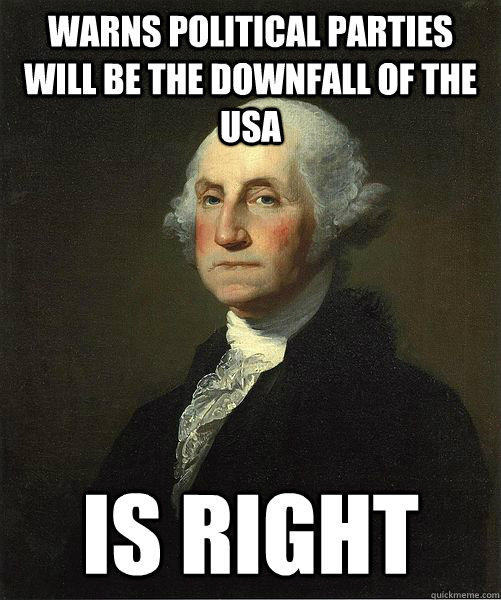
http://s.quickmeme.com/img/0d/0dab35c87ec69d4ee15ff9301e589c90bcd65333e6d95b0f2cd8e10b1210a8da.jpg

Sunday, October 19, 2014

Blog Assignment #8

1. From figure 8.1 in the text, select one of the interest groups and do some research on their issues and beliefs.  What did you learn?  What did you find interesting?  Do you agree/disagree with their positions on issues? Why?
A) I looked into the National Education Association and learned their primary goal in the promotion of increased student productivity and opportunities in public schools across the country. One thing that I found that was interesting was a policy briefing issued directly from the NEA discussing statistically findings of bullying in schools as well as recommendations for educators on how to actually handle bullying if they encounter it. It was enlightening to see their efforts outside of just the budget concerns and actual education standards for grading and district standings. I do agree with their positions on the issues of the public school system because coming from a public school in a state (CA) that spent almost half of its budget alone on education yet has placed 48th in educational rankings continuously, I have seen first hands the issues with traditional public schools and why I don't recommend them to parents and friends when asked.

2. Find an interest group with which you associate (positively).  What is the name of the group and what do you find persuasive about their position on issues?
A) I find the work that the interest group, The American Society for the Prevention of Cruelty to Animals, does important and positive. They're main goal is to take animals out of abusive environments, treat them, and find them forever homes. They are very persuasive because they are well-known for commercials showing neglected animals to sad music in an attempt appeal to people into donating to their cause. Furthermore, I am personally persuaded because I know that there are millions of animals that are treated cruelly, and I feel like I am actually helping when I involve myself in their efforts. Furthermore, they have monthly donation plans that cost about 60 cents a day. I feel like I have far less important things that I can give up the money from to go towards a cause like that.

3. Do interest groups have enough/too much/the right amount of power in the political system?  Most believe it's a fine-line balance between freedom of speech for the groups and keeping unfair persuasion out of government.  Where is that line and when is it crossed?
A) I think it depends on the interest group. Economic ones and more political ones that have to do with legislation or depend on government funding may have a tendency to have too much power in the political system. When they have a name that can make the public sway one way or another, that's when I worry about the scale of power. One incident that comes to mind is when Susan G Komen took away funding to Planned Parenthood when investigations proved that the funds they were donating to the group weren't being spent on mammogram exams but on other clinical uses. Planned Parenthood then turned it around and used its name to call Susan G Komen hypocritical and against women's health because of the pulled funding. This caused pressure from the public against the Breast Cancer group.

Blogs I Commented On: Katelyn Dozier, Donna Fox, and Matthew Cooper

Government and Interest Group Backing
http://progressivecynic.files.wordpress.com/2013/01/a-senator-not-a-nascar-driver1.png

Saturday, October 11, 2014

Blog Assignment #7

1. Does objectivity still exist in the media's coverage of politics?  Of the major news outlets (CNN, FoxNews, MSNBC, NPR, NBC, etc.), which are the most objective and which seem to have the most bias?
A) Yes, however, I think it is very rare nowadays for objectivity to remain intact. Primarily a lot of people view FoxNews as a biased news outlet due to the stories seemingly promoting the Republican and conservative, and I do think this is somewhat true. However, I think that a lot of other networks such as CNN and NBC are biased in the opposite way, pushing toward the Democratic and liberal views.
2. How does talk radio (Rush Limbaugh, Keith Olbermann, etc.) affect your view of politics?  Why?
A) I personally don't listen to much talk radio, though I sometimes hear advice stations, instead, but when I do listen to such things it can affect how I view certain political issues because conversations between the hosts can be interpreted, even by me, as accredited facts when they may not be. Thus, it pushed a political belief into my head or someone else's that in actuality may not have any basis.
3. Is media objectivity important?  Why or why not?
A)Yes, it is incredibly important because when opinions of right and wrong in political, social, and economic issues are voiced in a place that is designed solely for describing the news, it distorts the news itself and ends up encouraging its audience to pick sides. When the media is objective, then true opinions on the issue can be made because the real facts are all on the table.

Blogs I Commented On: Katelyn Dozier, Matthew Cooper, and Stephanie Steele

http://www.gamingpsych.com/wp-content/uploads/2014/03/44763666.jpg

Sunday, October 5, 2014

Blog Assignment #6

1. Polls:  http://www.cnn.com/POLITICS/pollingcenter/
Is American news media too dependent upon polls?  Is it appropriate for news agencies to create polls and then report on them?  Why or why not?
A) I think it is too dependent on the polls without additional data and research because they report on the general polls but many of these polls aren't comprehensive enough to really identify patterns and ideologies the of the people taking the polls. You could ask a question as simple as if the general public think Obama is doing a good job, and then make the answer choices too general, so it appears one way or another without explaining why. I think if the news wants to report on polls created by them, it has to be more detailed polls to give accurate answers.

2. How important is political party identification to you (e.g. as a Democrat, Republican, Libertarian, etc.)?  Was it more or less important to your parents & grandparents?  Does it seem more or less important to your friends?  Why or why not?
A) It isn't as important to me because there are things that one party or the other does on a case-to-case basis that I don't agree with. I think it was even less important to the previous generations because I think they really believed in the quality of the political officers, not their party. It's more important to many of my friends because they sometimes follow just what the media says about one party or the other and make an opinion based on that. If the media portrays one party as good this way or bad that way, many of my old friends based their opinions on that rather than the individual leaders in those parties.

3. Do you feel that you opinion of politics is more influenced by economic issues or by social issues?  Why?
A) Mine is more based around social issues because the economy will fluctuate back and forth, or maybe even crumble completely, but the humanity of people matters to me more. The morals of right and wrong are integrated back since the beginning of humanity and if my government wants to destroy what is right, I will fight it. I can't control where my paycheck comes from or if I will be able to afford milk tomorrow based on economic factors, but I can say if I think it's wrong for a person to take away another person's civil rights.

Commented on Student's Blogs: Matthew Cooper, Nikki Stair, and Taylor Wilson

Unreliable Polls
http://piazzablog.files.wordpress.com/2012/01/polls.jpg