Saturday, December 6, 2014

Blog Assignment #14

1. Read online bio's of the U.S. Supreme Court Justices.  What do you find interesting about their backgrounds?  Pick one of the Justices, read about cases this Justice has written (majority or dissent) and explain whether you agree or disagree with his/her judicial philosophy.
A) One interesting thing I noticed was that all of the Justices had law school backgrounds, but most of them additionally got their degrees in law from Harvard. Many of them also were law professors at one time or another. I looked into the cases of the Chief Justice, John G. Roberts, Jr. and I do generally agree with his judicial philosophy. The thing that made me agree with him more so was because he doesn't vote all liberal or all conservative. His voting and judgement seems to be based more on the individual cases than a party loyalty. Not all of his choices in the cases I agree with, but I do think he is thinking more for the people than himself or his title.

2. Is Judicial Review a power that should be exercised regularly or sparingly?  Why?
A) I think it shouldn't be exercised to an extensive amount otherwise things may never get passed, but it is important to be done on a regular basis to prevent Congress from passing superficial or selfish bills.

3. Is it the job of the High Court to apply the Constitution in light of the intent of the framers of the Constitution (strict construction) or should they interpret the Constitution in light of changes in society/technology (living Constitution)?  Why?
A) I think they must never loss the ideologies on which this country was founded on, but there are changes that must be made with a changing world. It would make no sense in today's society to own slaves or allow people to be executed by hanging as a regular punishment. Things must change as the time changes, but I do think that the Framers had reasons for why they made our country's government this way, and to make it the polar opposite would be a great disrespect and wrongdoing to do to them and our nation.

Blogs I Commented On: Matthew Cooper,Stephanie Steele, and Dylan Thevenard

Being a Law Student:
http://oyster.ignimgs.com/wordpress/write.ign.com/148779/2013/05/law-meme2.jpg

Friday, November 21, 2014

Blog Assignment #13

1. Research federal agencies and explain which one you feel is the most important one and why?
A) The most important federal agency and department to me is the Department of Defense and the Armed Forces. This department makes up the various arm forces, including Army, Navy, Air Force, etc. The people who serve our nation through the arm forces often are faced with great sacrifice. Sacrifice from their families, their social lives, their income, and sometime even the ultimate sacrifice of their lives all for you and me. So, to me that is the most important.

2. Which federal agency could be terminated with the least impact (if any) and why?
A) Most of the agencies seem very important so it was hard to narrow down ones that could be eliminated without aftermath. I did find that the Wirtz Labor Library was slightly less important in my opinion that some of the other ones. It's a library that holds records on labor, unions, grow and development, and while to some people that may be very important, on the list next to disability agencies, intelligence agencies, and so on seemed more important than it.

3. Are any new agencies needed?  In other words, if you were president would you create new agencies?  If so, in what area(s)?
A) There were a lot of agencies, but I noticed there didn't seem to be one on the educational purpose of a library or organization of religions. Maybe this was never created due to separation of church and state, but I think that for education purposes an agency for this reason could be very helpful. So many people don't get involved in religions because they just aren't informed. Some of this is self-inflicted, but I don't know how many times people have accused me, being a Christian, of believing in ridiculous things simply because they heard a rumor of such. I know there's even a lot of misconceptions between different denominations of the same religion, such as Baptists versus Southern Baptists or Catholicism, etc. So if there was an archive or library based agency on the education of this, maybe less people would be confused.

Blogs I Commented On: Matthew Cooper, Katelyn Dozier, and Nikki Stair

When the Government Agencies Close
http://i.imgur.com/P7o8mg5.jpg

Sunday, November 16, 2014

Blog Assignment #12

1. What makes a great President (not which Presidents have been great) . . . what qualities are essential to greatness?  Why?
A) They must have a clear set of goals for their presidency as well as thought out plans to put those goals to action. As for personal qualities, I think they have to have good time-management and not be a procrastinator in nature. They must have a strict work-ethic, being prepared to work long hours and go all over the globe. But I think most of all, they need to put the people's voice and priorities before their own. They cannot let selfishness get in the way of trying to do their best for their nation.

2. Other than Abraham Lincoln and George Washington, which two Presidents have been the greatest and why?
A) I think two of the most successful presidents besides the two listed were President Franklin D. Roosevelt and Ronald Reagan. President Franklin D. Roosevelt had two very tough issues to face early in his presidencies that many others didn't; he had to find a way to balance out the crumbling economy with the Great Depression, and he had to face the terrifying second part of a war that succumbed the globe, World War II. The fact that he held the country together during both crises to me makes him a great president. As for Reagan, while there were downsides to his terms, such as high deficits and federal spending, he cut taxes, fought hard to getting the Berlin Wall to fall as well as the oppressive forces of communism, helped to reduce inflation, and more. He had flaws in some of his ideas, but I respect his openness in his faith as well as his desire to get a US Constitution Amendment passed prohibiting the banning of public school prayer.

3. Research a President that you're previously unfamiliar with - list at least three things you learned.  Was this President effective?  Why or why not?
A) I really didn't know much about President Glover Cleveland. His wife was the youngest first lady ever, marrying him in the White House at the age of 21. He is also unique because he was the only president to serve two, nonconsecutive terms, being the 22nd and 24th President of the US. He was won the popular vote of the people in three presidential elections, 1884, 1888, and 1892, but lost the electoral vote in 1888. He was successful in his first presidency, cracking down on political corruption and promoting care for businesses, farmers, and veterans, but his second term started out disastrous in a way he couldn't reverse thanks to a national depression caused by Panic of 1893. However, he is known for his honesty and integrity even in his failures in his second term.

Blogs I Commented On: Katelyn Dozier, Matthew Cooper, and Donna Fox

President Dr. Who
http://treasure.diylol.com/uploads/post/image/644252/resized_conspiracy-keanu-meme-generator-what-if-the-president-was-a-timelord-who-changed-his-face-every-four-years-c8e942.jpg

Sunday, November 9, 2014

Blog Assignment #11

1. Who are your Senators and your Congressman?
A) In my district, the senators are Lamar Alexander and Bob Corker. The Congressman in my district is a congresswoman named Diane Black. Alexander has been incumbent since 2003 and Corker has been incumbent since 2007. Black is a more recent addition, having first been elected back in 2011.

2. Research the areas they champion and find one you support.  What is it and why do you also support it?
A) One issue Lamar champions that I agree with is his view on how ISIS should be dealt with. He isn't against using military force against the terrorist group, but he wants the President to come up with a clear set plan for which he can then present to the legislators to collaborate on. He believes that we can only be united as a nation on this issue if the branches of government work together.

3. Find an issue one of your Senators or Congressman champions that you disagree with.  Why do you disagree?
A) One issue I wasn't completely against but slightly disagreed with was Corker's decision to pass a bill called Energy Improvement and Extension Act of 2008. The idea being that people driving more environmentally friendly vehicles (specially electronic ones) would receive tax credit within a specific time-frame based on the energy they used electronically instead of through fuel. While the idea isn't a horrible idea, I think the reason I'm wary of it is the fact that it gives a select handful of people a tax credit for being able to buy a $50,000+ car that runs on electricity. That's great if you can afford such a car, but for the average populace that's sadly not an option. I'm all for saving the environment and cutting back on gas usage, but this tax credit would only be used for specific cases, and they budgeted that this bill would cost 150.5 billion dollars in ten years. Maybe ten years from now, I will be able to buy an expensive electric car, but as of now, this bill is completely useless to me.

Blogs I Commented On: Katelyn Dozier, Donna Fox, and Matthew Cooper

http://media-cache-ec0.pinimg.com/736x/28/cb/7f/28cb7f269f8d99b1bbfcea5658d9cd25.jpg

Sunday, November 2, 2014

Blog Assignment #10

1. Read Bush v. Gore in the text.  Do you agree with the majority or the dissenting opinion?  Why?
A) I agree with the majority opinion, but I understand the dissenting opinion. There were a lot of issues with this election and while they could have spent months recounting and re-looking at every aspect, it would've delayed the actual inauguration as well as could have proved pointless. It would have just been a lot of time and money spent on something that probably would have shown similar results. I can see why others would argue that we'll never know who actually won, but I think that there has to be a point where you stop and say, "I lost. That's it."
2. Is the ability to fundraise too important in elections?  In other words, are good candidates prevented from running because they cannot raise the needed funds?  Can/should something be done to correct this if it is a problem?
A) I do think it goes overboard sometimes. Sometimes I think that money involved helps to ween out some of the unprofessional candidates (candidates with pointless and odd campaign goals), but I do think it also limits some of the small town heroes we could gain in the political system. Everything is too money based nowadays. You want a job, pay to go to school for it, you want to write a book, pay your own money to self-publish it, you want to get elected, you need money to get everyone's eye. And while, I do think that it is a matter of how much effort you put into it, I think that if we could have more avenues to display all the candidates at the same time, such as a multi-candidate debate, then we could get some of these people with less connections in the limelight too. This isn't a popularity contest, it's the election of our world leaders.
3. Why is there such voter apathy - in other words, why is there often such low voter turnout for elections?  Is there a way to rectify this problem?
A) I think a lot of it has to do with self-identity and the disbelief that this person's vote matters. People who refuse to vote often to seem to think they have no chance of influencing the vote. I think if people would seek out stories of candidates overcoming party-dominant states or other odds, maybe people would see that even underdogs win and that their votes really do matter. Also if the subject matters enough to them, I think they'd vote. So I think voters have to personalize the voting to themselves to grow the desire to vote.

Blogs I Commented On: Donna Fox, Katelyn Dozier, and Matthew Cooper

Campaign Slogans...
http://rs1img.memecdn.com/vote-or-die_o_602734.jpg

Sunday, October 26, 2014

Blog Assignment #9

1. Which political party do you most identify with?  Why?  Are there things in the party platform with which you disagree?
A) I most identify with the Republican party because I have many conservative ideologies that match theirs. I do disagree with the way Republican party members may turn lack of federal government involvement into a lack of care to those that need government assistance. I do think that these systems such as welfare are abused sadly, but I do recognize that there are people that cannot live without such systems. Sometimes the Republican party can come across as uncaring because it is less supporting towards government assistance programs such as socialized healthcare and such.

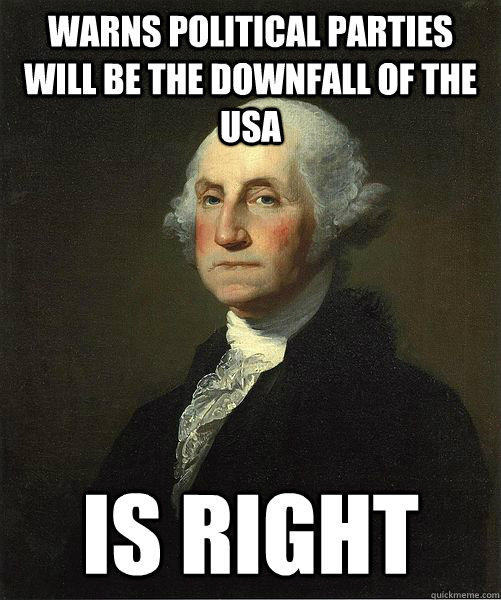
2. Does America need political parties?  The founders originally hoped that American politics would operate without need of parties?  Would that work today?  Why?
A) I wish it didn't rely on political parties but in today's day and age I don't know if people could willingly organize themselves strong enough to properly campaign and get their ideologies passed otherwise. Sadly, we have a lot of political ranters, people who whine about politics but have no plans or clue how to translate those opinions into actions. I do think it's sad that if you aren't attached to a party you have next to no chance of election otherwise, but I do think there are some advantages and necessary things that political parties add to the government.

3. Please research lesser known political parties - which one do you most identify with?  Why?
A) I identify with the American Conservative Party because it stresses many of the same things that the Republican party does but takes it stricter in wanting more social political issues to be state and local jurisdiction, not federal, such as marriage laws, abortion laws, and education standards. Some of the other minor parties were interesting to see. I had no idea there was a United States Marijuana Party or a Prohibition Party.

Blogs I Commented On: Donna Fox, Matthew Cooper, and Katelyn Dozier

Founding Fathers on Political Parties
http://s.quickmeme.com/img/0d/0dab35c87ec69d4ee15ff9301e589c90bcd65333e6d95b0f2cd8e10b1210a8da.jpg

Sunday, October 19, 2014

Blog Assignment #8

1. From figure 8.1 in the text, select one of the interest groups and do some research on their issues and beliefs.  What did you learn?  What did you find interesting?  Do you agree/disagree with their positions on issues? Why?
A) I looked into the National Education Association and learned their primary goal in the promotion of increased student productivity and opportunities in public schools across the country. One thing that I found that was interesting was a policy briefing issued directly from the NEA discussing statistically findings of bullying in schools as well as recommendations for educators on how to actually handle bullying if they encounter it. It was enlightening to see their efforts outside of just the budget concerns and actual education standards for grading and district standings. I do agree with their positions on the issues of the public school system because coming from a public school in a state (CA) that spent almost half of its budget alone on education yet has placed 48th in educational rankings continuously, I have seen first hands the issues with traditional public schools and why I don't recommend them to parents and friends when asked.

2. Find an interest group with which you associate (positively).  What is the name of the group and what do you find persuasive about their position on issues?
A) I find the work that the interest group, The American Society for the Prevention of Cruelty to Animals, does important and positive. They're main goal is to take animals out of abusive environments, treat them, and find them forever homes. They are very persuasive because they are well-known for commercials showing neglected animals to sad music in an attempt appeal to people into donating to their cause. Furthermore, I am personally persuaded because I know that there are millions of animals that are treated cruelly, and I feel like I am actually helping when I involve myself in their efforts. Furthermore, they have monthly donation plans that cost about 60 cents a day. I feel like I have far less important things that I can give up the money from to go towards a cause like that.

3. Do interest groups have enough/too much/the right amount of power in the political system?  Most believe it's a fine-line balance between freedom of speech for the groups and keeping unfair persuasion out of government.  Where is that line and when is it crossed?
A) I think it depends on the interest group. Economic ones and more political ones that have to do with legislation or depend on government funding may have a tendency to have too much power in the political system. When they have a name that can make the public sway one way or another, that's when I worry about the scale of power. One incident that comes to mind is when Susan G Komen took away funding to Planned Parenthood when investigations proved that the funds they were donating to the group weren't being spent on mammogram exams but on other clinical uses. Planned Parenthood then turned it around and used its name to call Susan G Komen hypocritical and against women's health because of the pulled funding. This caused pressure from the public against the Breast Cancer group.

Blogs I Commented On: Katelyn Dozier, Donna Fox, and Matthew Cooper

Government and Interest Group Backing
http://progressivecynic.files.wordpress.com/2013/01/a-senator-not-a-nascar-driver1.png

Saturday, October 11, 2014

Blog Assignment #7

1. Does objectivity still exist in the media's coverage of politics?  Of the major news outlets (CNN, FoxNews, MSNBC, NPR, NBC, etc.), which are the most objective and which seem to have the most bias?
A) Yes, however, I think it is very rare nowadays for objectivity to remain intact. Primarily a lot of people view FoxNews as a biased news outlet due to the stories seemingly promoting the Republican and conservative, and I do think this is somewhat true. However, I think that a lot of other networks such as CNN and NBC are biased in the opposite way, pushing toward the Democratic and liberal views.
2. How does talk radio (Rush Limbaugh, Keith Olbermann, etc.) affect your view of politics?  Why?
A) I personally don't listen to much talk radio, though I sometimes hear advice stations, instead, but when I do listen to such things it can affect how I view certain political issues because conversations between the hosts can be interpreted, even by me, as accredited facts when they may not be. Thus, it pushed a political belief into my head or someone else's that in actuality may not have any basis.
3. Is media objectivity important?  Why or why not?
A)Yes, it is incredibly important because when opinions of right and wrong in political, social, and economic issues are voiced in a place that is designed solely for describing the news, it distorts the news itself and ends up encouraging its audience to pick sides. When the media is objective, then true opinions on the issue can be made because the real facts are all on the table.

Blogs I Commented On: Katelyn Dozier, Matthew Cooper, and Stephanie Steele

http://www.gamingpsych.com/wp-content/uploads/2014/03/44763666.jpg

Sunday, October 5, 2014

Blog Assignment #6

1. Polls:  http://www.cnn.com/POLITICS/pollingcenter/
Is American news media too dependent upon polls?  Is it appropriate for news agencies to create polls and then report on them?  Why or why not?
A) I think it is too dependent on the polls without additional data and research because they report on the general polls but many of these polls aren't comprehensive enough to really identify patterns and ideologies the of the people taking the polls. You could ask a question as simple as if the general public think Obama is doing a good job, and then make the answer choices too general, so it appears one way or another without explaining why. I think if the news wants to report on polls created by them, it has to be more detailed polls to give accurate answers.

2. How important is political party identification to you (e.g. as a Democrat, Republican, Libertarian, etc.)?  Was it more or less important to your parents & grandparents?  Does it seem more or less important to your friends?  Why or why not?
A) It isn't as important to me because there are things that one party or the other does on a case-to-case basis that I don't agree with. I think it was even less important to the previous generations because I think they really believed in the quality of the political officers, not their party. It's more important to many of my friends because they sometimes follow just what the media says about one party or the other and make an opinion based on that. If the media portrays one party as good this way or bad that way, many of my old friends based their opinions on that rather than the individual leaders in those parties.

3. Do you feel that you opinion of politics is more influenced by economic issues or by social issues?  Why?
A) Mine is more based around social issues because the economy will fluctuate back and forth, or maybe even crumble completely, but the humanity of people matters to me more. The morals of right and wrong are integrated back since the beginning of humanity and if my government wants to destroy what is right, I will fight it. I can't control where my paycheck comes from or if I will be able to afford milk tomorrow based on economic factors, but I can say if I think it's wrong for a person to take away another person's civil rights.

Commented on Student's Blogs: Matthew Cooper, Nikki Stair, and Taylor Wilson

Unreliable Polls
http://piazzablog.files.wordpress.com/2012/01/polls.jpg

Sunday, September 28, 2014

Blog Assignment #5

Regarding civil rights and discrimination, please address;
1. The issue of race - does the government do too little or too much to reduce the instances of racial discrimination?  Why or how so?
A) I think sometimes the government actually does a little too much to reduce the instances of racial discrimination. I don't say this to be confused with condoning discrimination, but because of it we have a nation of people who believe that they can say anything they want if it pertains themselves and little to nothing if it pertains to others. The issues of political correctness has become a double-edged sword. I think the actual legally regulations on discrimination are more relaxed than the public agenda promoted by the government on this issue, but it still is sometimes too involved in these disputes.
2. The issue of gender - same question as #1.
A) I think the government is neither too involved or too relaxed regarding gender discrimination. I think there are instances where gender discrimination is still alive in places, like the workforce sometimes, but I think that for the most part men and women have a lot more equality in these instances than they ever had. I also want to stress the term equality there, not feminism, because I truly believe that men vs women viewpoints can so easily be blown out of proportion today, and like I said about political correctness, it is also a double-edged sword.
3. The issue of sexual orientation - same question as #1 and #2.
A) This one I think the government is has done too little to reduce the instances of discrimination, but I think this is mainly due to it only recently gaining more civil rights movements to back it. I don't say this to promote sexual orientation as right or wrong, but more specifically the discrimination of it. The nation has to mature in this aspect so that we can learn to love all people and not shun them, regardless of if we agree for or against the issue. I have lost one too many friends to the hatred that has rallied against homosexuals and other sexual orientation groups.

Blogs I Commented On: Nikki Stair, Donna Fox, and Matthew Cooper

Double Standards
http://www.vrouwen.nl/files/0/0/0/3/00036581.jpg

(FYI, the picture is not meant to offend, it is meant to be comical, and if it did, you may have just proven my point...)

Wednesday, September 17, 2014

Blog Assignment #4

1. Freedom of Speech:  How important is it?  Does the freedom go "too far"?  What areas of speech should not be protected?
A) There are some forms of freedoms of speech that stretch the limit on what is too far. However, I don't think this should be confused with political correctness. Political correctness is more of an attempt to make certain things publicly acceptable to say. Such things that fall into the idea of "political correctness" is saying that a man shouldn't call a women certain terms due to it being degrading to women, or not calling different races different identification terms, such as not calling a person "Black," but instead "African American." While I think that there is some basis to political correctness, there is taking it too far in an attempt to censor the freedom of speech.
However, I think that any form of speech that limits or takes away another person's rights is going too far. For example, if a person threatens bodily harm against someone, that can be interpreted as a form of attempting to take away someone's civil rights. It depends, but I do think that any word that comes out of a person mouth or is written to forcefully take away another person's civil rights should not be protected.

2. Freedom of Religion:  Is separation of church and state necessary?  Why or why not?
A) Yes, I think that there is a time and place for religious matters and political matters. I do think, as a Christian myself, that there should be freedom to express those religions even in political matters as long as it doesn't take away another person's civil rights. For example, if I say a prayer at a lunch meeting with my coworkers as long as it doesn't interfere with their meeting or civil rights, then I find nothing wrong with my actions. Or if a person asks not do or eat something for religious preferences, they should be legally allowed within the limits that it isn't forcing others to adhere to the same ideals. Keep in mind the strictness I use the term "force" here because this has been an issue that has been strongly debated on when the freedom of religion is challenged in judicial interpretations.

3. Criminal Procedure:  Are defendant's rights crucial to our system of government?  Why or why not?  Many argue that defendants have too many rights - do you agree?  Why or why not?
A)Yes, they are because if defendants didn't have the rights they had such as the need for a warrant, freedom to plead the fifth, and so on then our judicial and legal system would be corrupt. People would be forced to speak in interrogations regardless of their civil rights. They could be charged of crimes that they weren't even aware they'd been accused of, and the police could seize and raid any property of the defendant. The rights to defendants are very important to keep the American public, both innocent and guilty equally safe and fairly treated in the judicial system.

http://i2.kym-cdn.com/photos/images/newsfeed/000/222/965/lib.jpg


Bloggers I Commented on: Katelyn Dozier, Donna Fox, and Matthew Cooper

Sunday, September 14, 2014

Blog Assignment #3

1. Is a strong national government necessary or should the state governments have an equal share of power?  Why?
A) It is important for there to be equilibrium in the amount of power between the states and government because if one or the other has too much power, it will at some point take over the other, like we saw in the America born around the Articles of Confederation, which caused the states to overpower the Congress. There are things that need to be stronger in some aspects for one side versus the other, I think, but only with the realization that it as a whole adds up to a equal checks-and-balance of political power.

2. National power increased during the Great Depression but then power began to shift back to the states (somewhat) during the Reagan administration?  Why did that happen and is that shift appropriate?
A) This happened because as it reached the age of Reagan's administration, the economic situation in the US was improving and the need for reliance on the Federal government, economically was naturally decreasing as well. Reagan was attempting to ween the American public off the federal aid so that they wouldn't abuse the system and that the states could handle the smaller financial and political issues on their own.

3. Education stirs much discussion relating to the issue of federalism.  Should the national government regulate education or is it a matter best left to state and local governments?  Why?
A) It should be a bit of both because there sadly is too many states that by their own power are failing. I came from California which was one of the worst in that it spends some of the most tax revenue on education and yet produces the same or lower than average test scores. So, it's true that the Federal Government has to be involved somewhat. However, it doesn't need to be controlled solely by the Federal government because that results in more debt and changes needed to other parts of the national budget that could be used elsewhere.

http://i2.wp.com/www.sycmu.com/wp-content/uploads/2012/11/60551_453075371416670_32171113_n.jpg?resize=366%2C411

Blogs I Commented On: Taylor Wilson, Nikki Stair, and Matthew Cooper

Sunday, September 7, 2014

Blog Assignment #2


1. Why is the United States Constitution stronger than the Articles of Confederation?  How would the history of the United States have been different if the country still operated under the Articles?

The Constitution is more united in that it gives a more equalized approach to Federal and State government. The Articles of Confederation didn't have a checks-and-balances system to keep one from overpowering the others, so revolts and chaos ensued when the federal government would attempt to govern the states.

2. The first three articles of the Constitution establish/define the three branches of government - read these articles.  What did you learn that you didn't already know about our government?

I did not know that the Supreme Court had the power of judicial review, in other words, the power to remove a law that would break the rights presented in the Constitution. I always wondered why it seemed that judges were ruling against bills that the people and congress had passed such as Proposition 8 in California to retain the marriage definition as between a man and woman. It makes more sense as to why a Court judge can call something 'unconstitutional' and change it.

3. How important is the Supreme Court ruling in Marbury v. Madison and why?

The importance of the ruling in this case was that it further established the rule that even Supreme Court was subject to rules and regulations of the Constitution. It showed that they couldn't judge on cases outside their jurisdiction, and further affirmed that they could not abridge the Constitution's guidelines. This paved the way to judicial review to prevent Congress from passing laws that gained power over the Constitution, thus proving the Constitution had supreme power over the law. This is important even today because it is one of the checks-and-balances that keeps the three branches of government equal in power.

4. Looking at the United States government today, is it more like what the Federalists or the Anti-Federalists envisioned and why?
I think it's more of what the Federalists envisioned because there is a lot more dependency and focus on the federal government's involvement in public interest, rather than state dependency. Slowly, I think that the Federal government is becoming the focal power of the American people rather than the State power due to government dependency and how the Constitution is interpreted today.

Bloggers I commented on: Dylan Thevenard, Stephanie Steele, and Donna Fox

Friday, August 29, 2014

Welcome to American Government-SHam

Hello, and welcome to my American Government Blog. If you are confused by the description in the far right corner that is because this blog is attached to my old blogger account (Brushfire1412).
Regardless, let me introduce myself. My name is Sarah Ham. I am a 20 year-old sophomore at Roane State. This is my fourth semester and also, my last before I plan to transfer to the University of Tennessee, Knoxville. My major here at Roane is a transfer major, Associates of Science in Education, Concentration, Special Education. I hope to graduate from UT with a Bachelor's of Science in Special Education, Concentration, Deaf Interpreting.
After graduation, I hope to become a Deaf Interpreter, and overall be a help to the Deaf community. I truly believe that Deaf people have so much more to offer than we give them credit, and I want to bring awareness to that fact.
I look forward to this semester in this class because I hope to learn more about the government that this nation was formed around. I have come to find myself complaining about things our government does that I don't agree with, and I'm tired of arguing about these things when I'm not educated enough to see what our government legally can and can't do. I hope this class will inform me of some of the stepping stones of where we as a nation have grown to be today.
http://m.memegen.com/fn135e.jpg